es
es en
en fr
fr it
it ru
ru ar
ar zh-hans
Qui sotto puoi leggere una traduzione del traduttore umano in inglese. Hai anche accesso all’originale spagnolo cliccando sulla bandiera nell’angolo in alto a destra. Questo link ti consente di accedere a una versione di traduzione automatica di Google in italiano: http://bit.ly/2JiJZ4T
There are several fractures of the upper limb with profoundly limiting effects on the patient’s daily life, if they are not treated as required. One of them is the breakage of the radius, in its different forms, also known as Colles fracture.
The radius withstands the wrist, so it plays a central role in any movement of the hands that we can imagine. Broadly speaking, this bone is responsible for articulating the connection between hand and forearm, therefore all injuries have a high cost for our motor abilities.
Loss of strength, pain, difficulty performing tasks that involve the ‘mechanism’ of the wrist (…) various problems whose surgical solution we speak today about with Dr. Francisco del Piñal, author of ‘Arthroscopic Management of Distal Radius Fractures’
Dr., in previous conversations about the most common clinical scenarios you address you have highlighted, on several occasions, those that affect the radius (…).
Yes I have. Radius injuries are very common, in fact it’s the most frequent fracture in the human body. We treat many patients with fractures of this profile or with sequelae of previous traumas.
Any factor that makes us more prone to suffer a fracture of these characteristics?
They occur -mainly- in two age groups: young people with fractures due to high energy mechanisms (accidents at work, car accidents, sports accidents, among others) and elderly people who break their wrist in ‘minor’ falls, due to osteoporosis, bone weakness, etc.
Are they addressed differently?
Yes, indeed. In the case of the first group -young patients- radius fractures are very complex because they usually affect the joint. In general, the fracture point is different than in the elderly. In addition, it is essential to give an adequate solution, because, under normal conditions, the area will work intensively for several more decades.
When a good reduction is not achieved, the result is the development of and early osteoarthritis and pain. Besides, there is an additional reason: while in the elderly patient, which we will talk about later, the affection is restricted to the bone, in the young the damage occurs on the joint (…) and the joint does not forgive any irregularity. This is where arthroscopy plays a fundamental role.

An addition, Dr. It’s usually noted that for years there was a tendency to downplay certain fractures in the older groups. What is your perspective?
If we talk about the elderly, despite their lower activity, the radius fracture must be given great importance because it’s extraordinarily limiting; in age groups that, moreover, currently are totally autonomous: they drive, they take care of their grandchildren, they deal with household chores, etc. A radio fracture can kill off all of that activity.
The intervention allows to anatomically restore the damaged area and gives back its functionality, and very fast. In about four weeks, the patient can already do 90% of the tasks he performed prior to suffering this setback.
Any recent medical or technical breakthroughs that stand out?
From my point of view, there are two fundamental advances in the treatment of radius fractures: on the one hand, the improvement of the plates that, as a support, allow us to bear the reduction of the fracture; on the other, and this is where the jump is greater, the possibility of making anatomical reductions through arthroscopy.
In this sense, wrist arthroscopy allows us to control the most difficult part, the joint surface, that is, how the cartilage ends up. Its state will determine the success or failure of the intervention. If there is the slightest displacement, one or two millimeters, that won’t be good, especially for a young person.
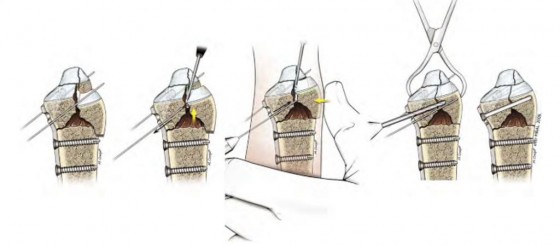
Video: Dr Del Piñal performs a reduction of radius fragments that are causing an articular step-off. View of the joint in a wrist fracture
What is the function of the cartilage?
I will try to give a short answer. There is no ‘bone to bone’ contact in the joints, but ‘cartilage with cartilage’. They are usually compared to the absence of friction that occurs when two ice cubes are rubbed for a while. If that is lost, the bones collide, something similar to rubbing two sandpapers (…) they wear out between them and pain is generated.
Thereby, the cartilage provides a surface that prevents the mentioned abrasion, allowing a friction of zero in the joint area.
Dr, you have a very broad trajectory in the handling of this type of fractures, including international publications, is it a simple procedure for you?
Although we get great results, it can’t be said that it is a simple operation. However, our experience is very broad in this area, yes.
In fact, my surgical and research work underlie part of the use of the arthroscopic technique in this context. Specifically, in the simplification of the procedure, which has facilitated to popularize among many specialists -hand surgeons and arthroscopists- the technique we are talking about.
Thanks to all of this, the patient’s prospects have changed substantially. Before a radius fracture was a major limitation but not now. Even people already treated and suffering from sequelae benefit from new solutions.
ADDITIONAL SPECIALISED INFO: