es
es en
en fr
fr it
it ru
ru ar
ar zh-hans
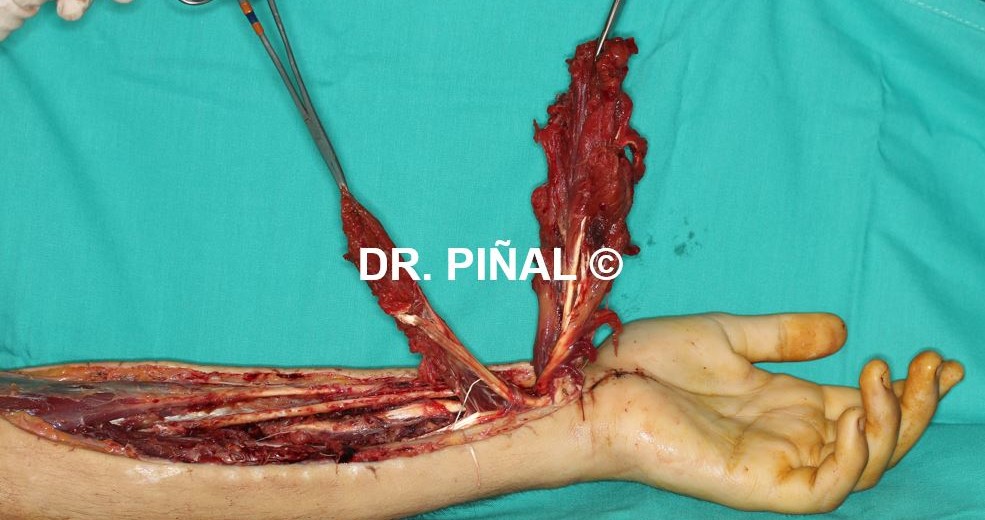
Young patient, 17-year-old man, wrenched flexor muscles of the forearm due to a severe trauma in traffic accident, with tendon injuries and nerve damage. Dr. Piñal designs a scheme for approaching the case through microsurgery, with a transfer of the gracilis muscle or internal rectus.
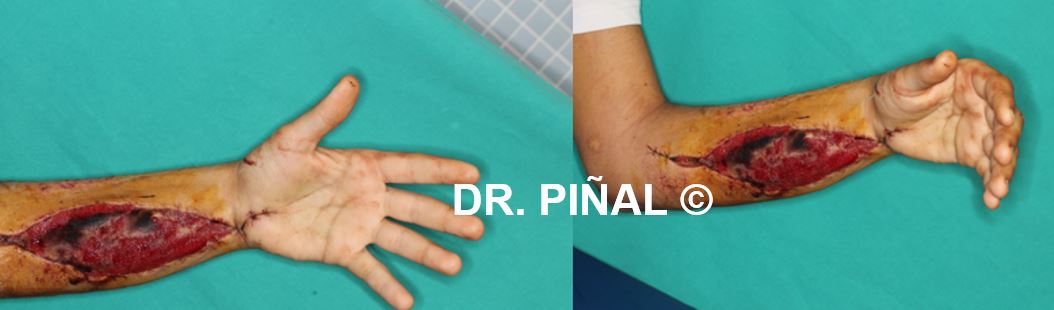
The problem
After his accident, the patient visits the clinic of Dr. Piñal with an emergency muscle ‘repositioning’ that does not solve the serious functional problem and, on the contrary, represents a risk of sepsis, ie, infection of the affected area.
The objectives
The clinical goals of Dr. Piñal and his surgical unit are to restore the limb function, to preserve sensitivity and to minimize, to the extent possible, the aesthetic impact of the trauma and subsequent intervention.
The plan
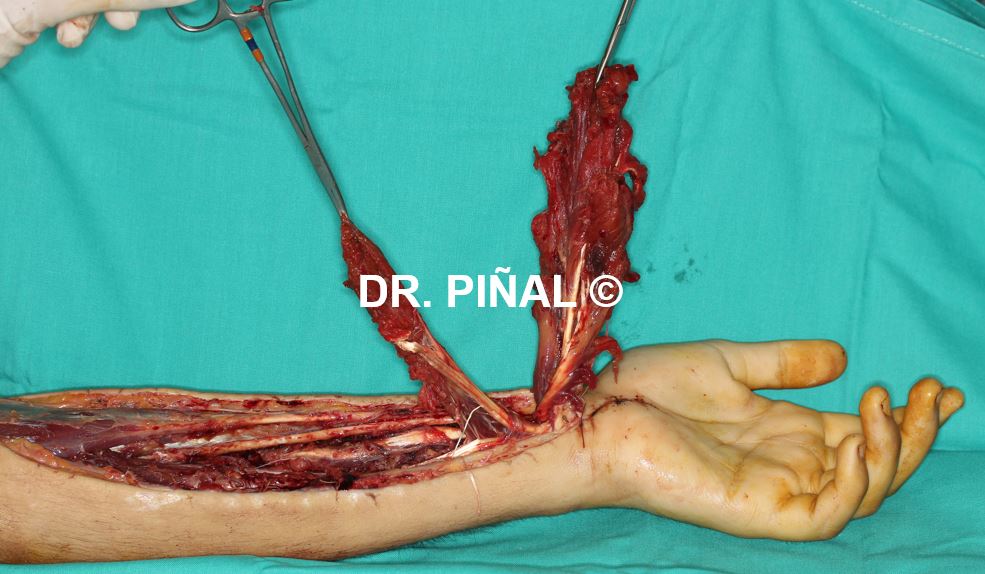
The severity of the lesions suffered leads to necrosis due to devascularization of the affected tissues, which necessitates resection, that is, the emptying or withdrawal of the entire damaged muscle-tendon section.
Once the resection is performed, Dr. Piñal proceeds to transfer the internal rectus muscle or gracilis of the patient with its corresponding vascular (artery and vein) and nerve structure. In this way, a muscle with a secondary function on the inner side of the leg is reconnected by microsurgery in the forearm, transforming its role.

At the same time, as a common factor in this type of clinical context, the existence of several tendons with the same functional mission in the upper extremity allows to complete the recovery of the mobility of the forearm, by means of its deviation and reconnection with the transferred muscle.
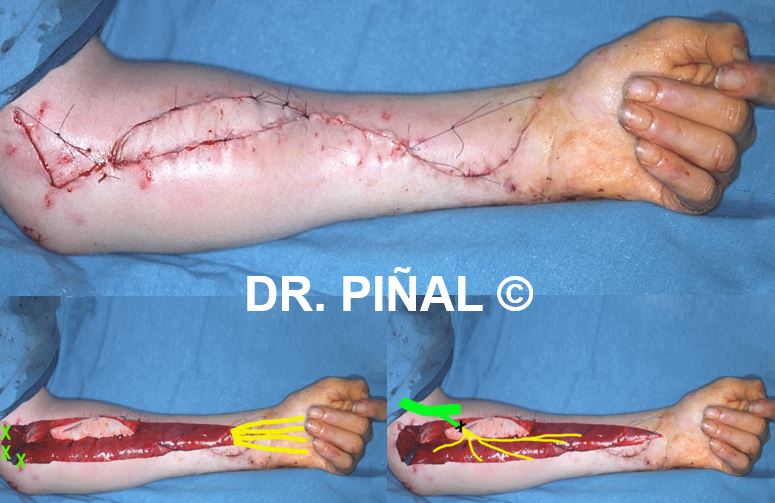
On the other hand, the gracilis muscle is accompanied by the surgical incorporation of a cutaneous island, which acts as a monitor of the success of the revascularization process, among other variables.
The results
The response of the muscle to the lack of oxygen makes vital to shorten the time of procedure. In this case, after about 6 hours in the operating room, the results in both the motor function and the aesthetic point of view are satisfactory; to this latter variable also contributes the later resection of the cutaneous island that acted as an indicator.